
Blog
-

-
Senior Operations Officer, IFC
-

-
Executive Director, Peruvian Mining, Energy, and Oil Association (SNMPE)
Jan 28, 2025
Misconceptions can travel fast on social media. But when harnessed properly, social media can be a powerful force for good—strengthening company-community relationships, building trust and capacities, and influencing more accurate perceptions of company contributions to communities.
IFC’s experience in the mining communities of southern Peru offers valuable insights about the benefits of using digital tools for engaging citizens and counteracting the spread of misinformation by equipping local leaders and influencers with knowledge—and encouraging them to share it on their own social platforms.
In 2021, IFC’s From Disclosure to Development (D2D) program set out to leverage social media as a way to improve access to accurate, reliable information and strengthen community engagement in Moquegua—a mining region with a long history of community participation in decision making, especially on public budgeting. In collaboration with the Peruvian Mining, Energy and Oil Association, D2D created Infovoces Moquegua, an innovative project designed to increase access, understanding, and use of credible information related to mining and local development.
The project took place in a region that is home to less than 1 percent of Peru’s population, but ranks fourth in income generated from mining activities among all regions in this resource-rich country. Overall, the region has thrived economically and socially as a result of the mining activity. But a closer look reveals a prosperity imbalance, with mining districts outperforming non-mining districts. With the region’s dependency on mining, along with the social and economic disparities, an opportunity arises to foster the participation of a well-informed citizenry in the decision-making of local governments by providing access to understandable and useful information about local development in Moquegua. This would help ensure the enacting of local policies, plans, and public investments in the best interests of local residents across all districts in the region.
Enter Infovoces Moquegua. Beginning with a mapping exercise to identify and understand local leaders’ interests, media consumption, and information gaps, the program produced seven virtual training modules for streaming on WhatsApp and Facebook, reaching more than 240 civil society leaders. Modules addressed topics ranging from digital literacy, mining, and local planning and budgeting to diversity, gender, and leadership. An in-person component complemented the virtual learning. The result? Greater understanding about mining and its contributions to local and national economic development—and increased willingness on the part of citizen activists and community leaders to share what they had learned. At the start of the project, only 12 percent of participants were able to disseminate facts about mining’s positive impacts. By the end of the project, the percentage of community leaders who could share reliable information had more than doubled, to 27 percent.
Here are three lessons from the experience, applicable for similar projects in other contexts.
Lesson 1: Less is more; short is best
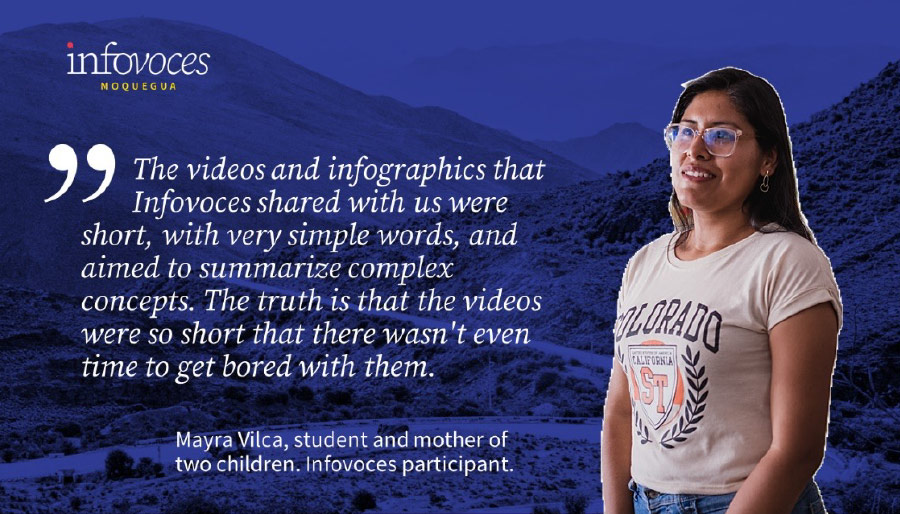
Concise digital messages are key for community engagement as they make information easier to understand, access, and share. Infovoces Moquegua produced more than 100 short information pieces and explainers. And the short form is what attracted Mayra Vilca, a young student, and a mother of two. Though she was always interested in politics, limited free time prevented her from engaging in any political activities. After signing up for Infovoces Moquegua, and viewing a few of the brief clips, she realized she could engage with the training content during her daily two-hour bus commute, allowing her to focus on the learning despite her busy schedule.
Lesson 2: Live connections remain essential, even in today’s virtual world
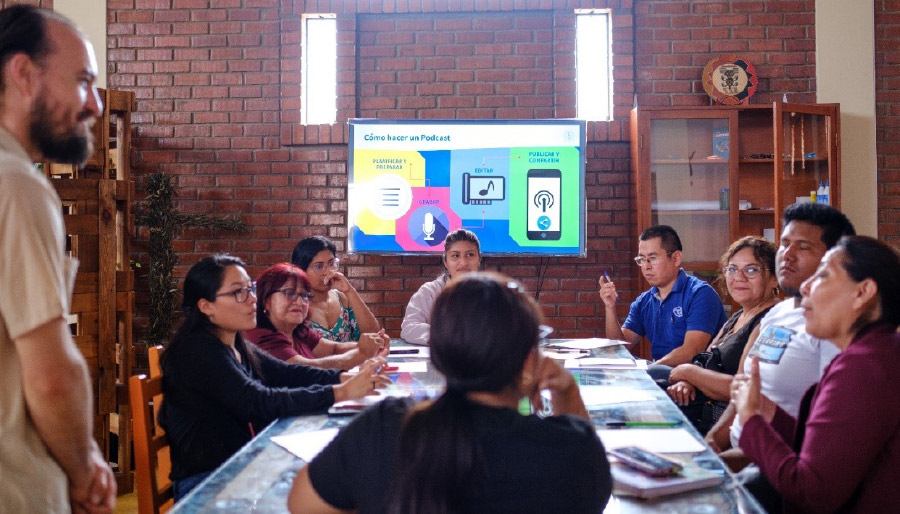
Complementary in-person interactions are key to developing trust, building relationships, and maximizing learning in digital community engagement. Gladys Salina reported that the live workshops were a pivotal moment in her involvement with Infovoces Moquegua, as they allowed her to develop a closer relationship with the organizers and other participants. A keen appetite for learning drove her to join Infovoces. She has been a neighborhood representative for the past 25 years, holding various roles from leader to manager of community kitchens. After the in-person meeting with peers and the project team, Gladys became even more engaged, collaborating on a podcast about community leadership.
Lesson 3: Women’s engagement generates a positive ripple effect
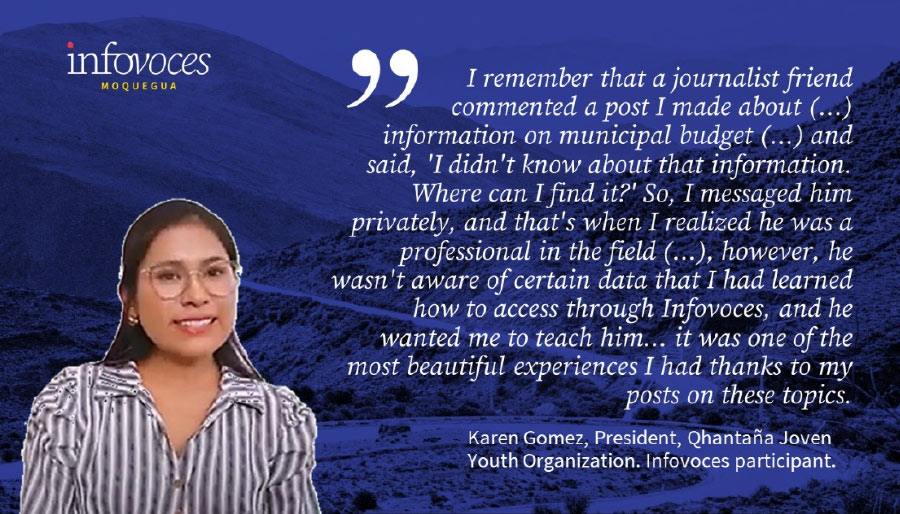
Infovoces’ gender strategy encouraged the participation of female leaders of all ages, yielding a cohort of highly engaged women. Making up 53 percent of participants, women also represented two-thirds of those who completed all seven training modules. Notably, women leaders demonstrated better outcomes in accessing, understanding, and using mining-related information compared to their male counterparts and their baseline data. Karen Gomez is among them—the president of a nonprofit used to be among the only women at the table in a room filled with men. Using the knowledge she gained, she proceeded to post insights on social media that enlightened journalists and community members alike—demonstrating both the positive power of social media—and the impact of Infovoces.
Learn more about their experiences here:
Related Content

Metals and Mining Hold the Key to the Energy Transition. Gender-smart Businesses Can Be the Driver.
Digital Inclusion
Mining


Interview with Saifoulaye Balde: Matching small suppliers and big buyers in Guinea’s mining sector
Digital Inclusion
Mining
