
Blog
-

-
Regional Manager, Pre-Investment & Advisory, Infrastructure & Energy, Europe & Latin America, IFC
-

-
Sustainability-Linked Finance and Latin America Lead, Sustainable Infrastructure Advisory, IFC
Dec 12, 2023
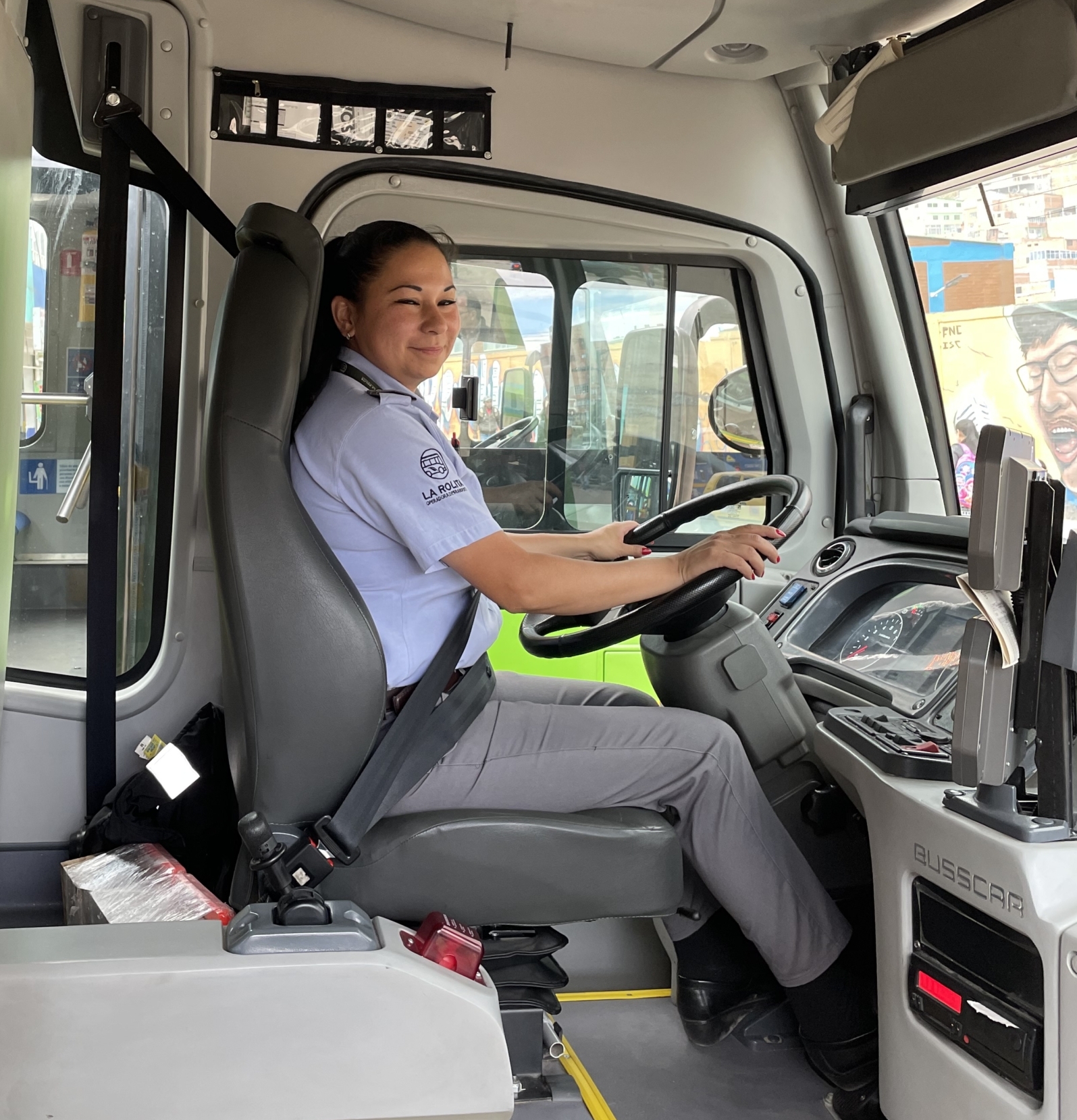
La Rolita operator, Diana Rodríguez, about to start the Arborizadora Alta route. Photo: Amanda Díaz Ramírez, IFC
In a culture where job roles are often prescribed based on gender, it’s one thing for a company to emphasize hiring women; it’s another to achieve results that transform the very nature of the company. It all starts with changing hearts and minds about the kinds of jobs women can do.
A group of municipal officials and mobility experts in Bogotá, Colombia, faced this challenge as they discussed a gender-inclusive vision for the city’s newly created electric bus company. Called “La Rolita”— a local idiom meaning “woman from Bogotá”—the company aspired to a workforce of mostly female bus drivers.
But how to achieve this goal, part of a broader municipal strategy of creating jobs for women in traditionally male-dominated sectors?
Improving women’s employability in the city’s transport sector
The effort began with the city providing driver training for a target set of women—heads of households from low-income communities who could drive a car but lacked the license and expertise to operate an electric bus. It was a successful effort: In 2022, when La Rolita’s new fleet of 195 all-electric buses rolled onto city streets for the first time, many had women at the wheel.
This was a great start. But it gave rise to another critical issue: How could the company ensure that the women it had trained and hired would stay?
After all, these newly minted bus drivers had to juggle the demands of work and home. Many faced lengthy commutes. Security was also an issue, particularly for those assigned late night or early morning shifts. IFC, the city’s long-time partner on projects fostering inclusion and sustainable growth, helped address these challenges. For example, in 2018, IFC’s support spurred the construction of the TransMiCable cableway, connecting some of the city’s poorest neighborhoods to public transit hubs for the first time.
Using its well-tested tools and expertise, IFC’s gender and infrastructure team advised La Rolita on ways to achieve its gender goals. In tandem, the team looked more broadly at the city’s transport sector, developing a framework to build and sustain a gender-inclusive workforce at the industry level.
IFC’s framework for a Sustainable Gender-Inclusive Workforce in the Transport Sector*
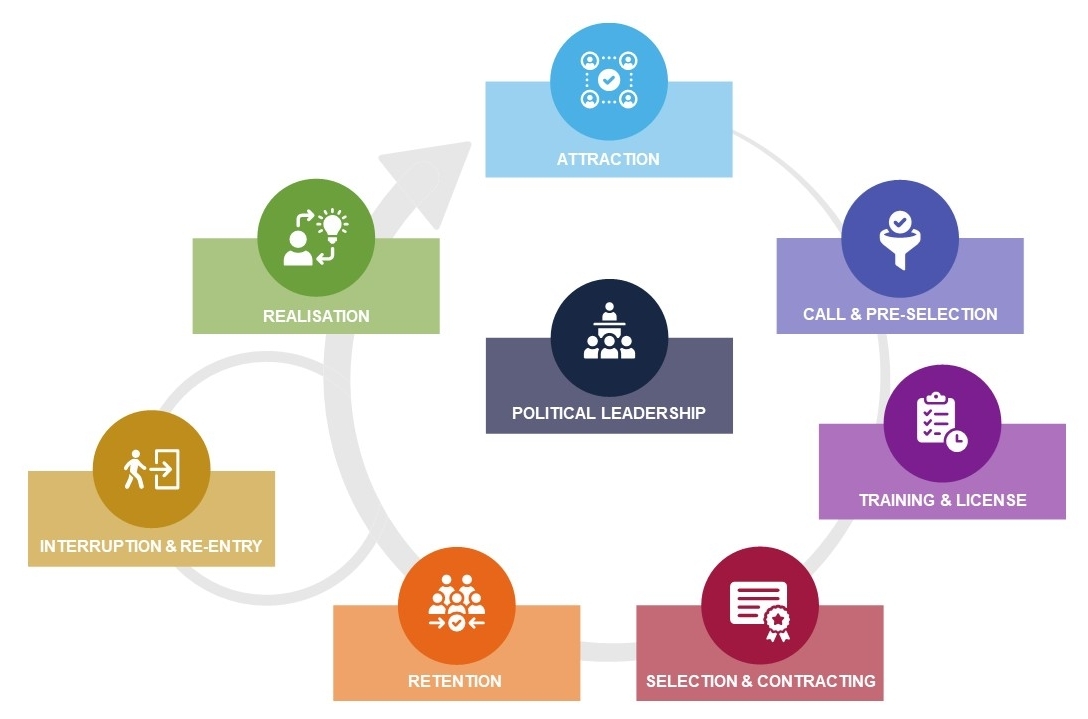
*Based on ILO’s Women’s Career Cycle in the Transport Sector (2013).
“IFC guided us on weaving gender inclusion into La Rolita’s DNA, as well as how to achieve progress across our entire transport sector,” the Secretariat of Mobility noted.
The IFC team highlighted how inclusive workplace policies and procedures would be critical to ensure that the women drivers remain with the company. This meant flexible hours. It meant family-friendly employment benefits, such as affordable childcare. And it meant appropriate infrastructure along the route, like modern restrooms.
La Rolita has taken the advice to heart, enhancing its policies and procedures. Following IFC’s recommendation, La Rolita pursued and obtained a local gender seal granted by the Secretariat of Women’s Affairs of Bogota. The next step is exploring options for on-site childcare.
Efforts to build an inclusive company culture have paid off in a big way
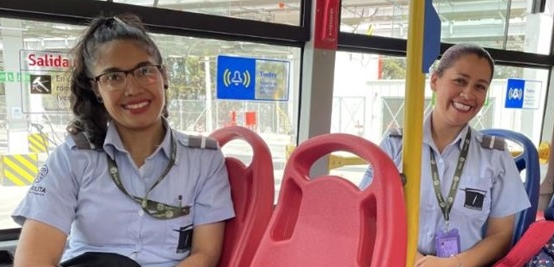
Karen Dayana Martín and Yury Rocío Alvarado Trujillo, women drivers at La Rolita’s headquarters, share experiences as transport sector pioneers. Photo: Amanda Díaz Ramírez, IFC
Today, La Rolita is a public-private company, jointly owned by the city and Enel, a global green energy player. The company’s 10 routes, some passing through underserved neighborhoods, cover more than 230 miles. And about 60 percent of La Rolita’s bus drivers are women—a remarkable statistic considering the 1.4 percent women’s participation rate in Bogotá’s public transport sector as of 2022.
La Rolita’s women e-bus drivers report tremendous job satisfaction. “The best thing about this job is that my take-home pay covers my expenses,” says driver Sara Montiel. “Before La Rolita, it was much harder to do that because I was earning a minimum wage.”
A recent driver survey affirms that the bigger issue of culture change is also underway.
“I hope that we can continue showing that women can do the same jobs as men,” wrote one survey respondent.
“From the time I was a little girl, I always wanted to drive a taxi [but couldn’t imagine it happening]. And today, when I see myself, I’m driving a bus! It has made me want more,” another commented.
Indeed, as La Rolita’s buses crisscross the city with proud women in the driver’s seats, many more of Bogotá’s little girls and women can imagine careers in transport.
IFC’s work with La Rolita is part of a comprehensive approach to encourage increased investment in e-mobility solutions for cities in emerging markets—as a way to expand access to public transport, create jobs in the new green economy, increase opportunities for women, and promote climate-friendly urban services.
Click here for more on IFC’s work at the intersection of gender and infrastructure
Click here for IFC’s toolkit ‘Engineering Inclusivity: Infrastructure for Everyone”
Click here for more info on IFC’s work in transportation
Read the Blog in Spanish: Bogotá, mujeres al volante
Related Content

Why Women are Essential for Climate Action: A Conversation with Franziska Deininger
Gender
Inclusion
Sustainable Cities


In Bogotá, Impact Mapping Shows Covid-19’s Strain on Women Caregivers
Gender
Inclusion
Sustainable Cities
