
Water and Communities
Low Cost, High Yield: The Adaptation and Resilience Investment Opportunity for Infrastructure
This report makes the business case for embedding adaption and resilience into infrastructure development and asset management with a focus on private operators and investors.
Social KPIs Matter: Setting Robust Indicators for Sustainability-Linked Finance (Updated)
This draft paper highlights current trends in the use of social key performance indicators (KPIs) in Sustainability-Linked Finance, with a focus on the infrastructure sector.
Brochure | Sustainability-linked Finance
Sustainability-linked finance (SLF) is a powerful tool for mobilizing capital as the world moves towards a greener global future. SLF incentivizes companies to pursue ambitious, long-term environmental and social goals, and its use can help countries achieve the 2030 UN Sustainable Development Goals.
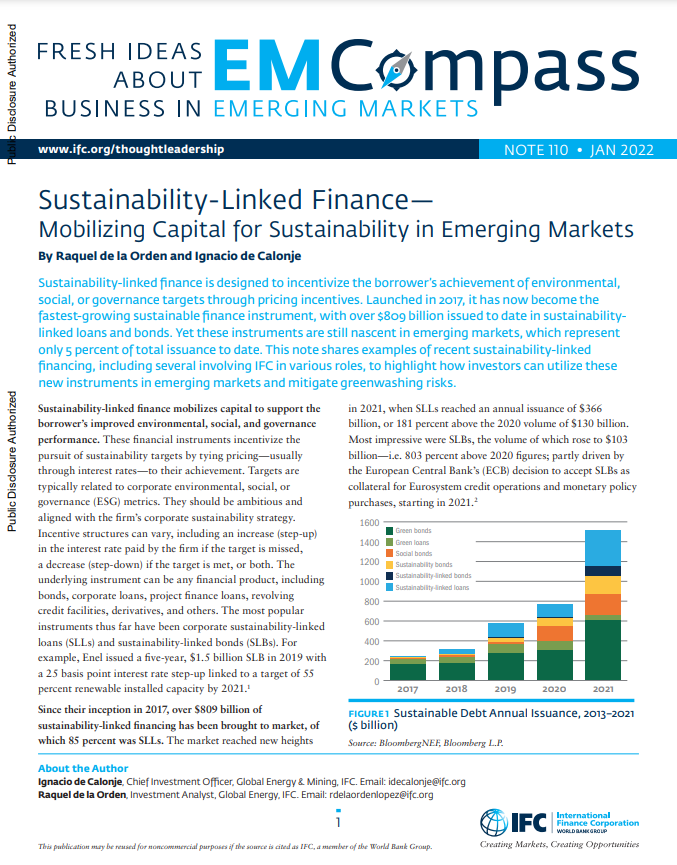
Sustainability-Linked Finance—Mobilizing Capital for Sustainability in Emerging Markets
This note shares examples of recent sustainability-linked financing, including several involving IFC in various roles, to highlight how investors can utilize these new instruments in emerging markets and mitigate greenwashing risks.
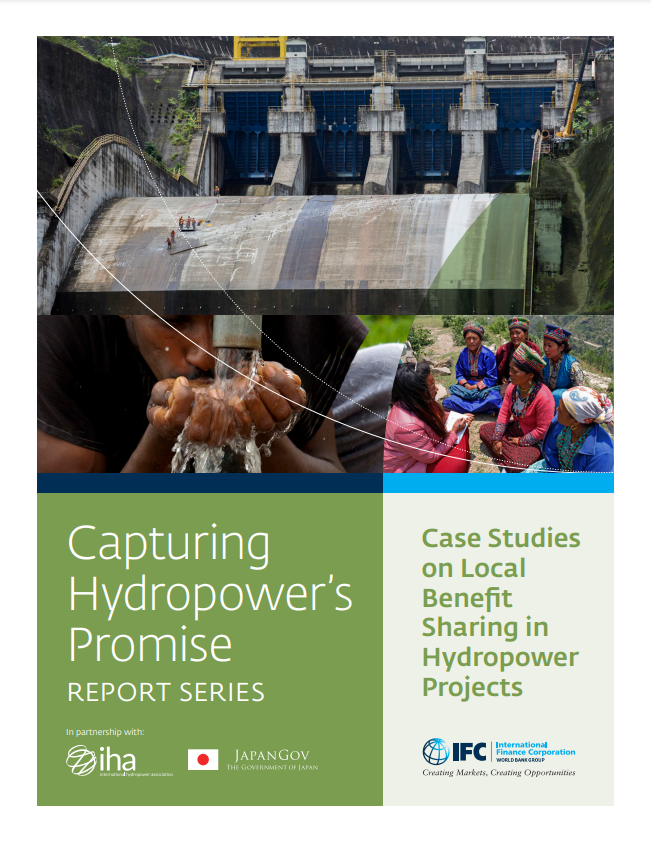
Capturing Hydropower’s Promise: Report Series
The series Capturing Hydropower’s Promise features suggested approaches on implementing local benefit sharing in hydropower projects, along with good practice examples.
The Role of Indigenous People in Major Project Development – Part II Indigenous Ownership of Electricity Infrastructure: A Case Study
This paper aims to help enable the increased adoption of Indigenous equity ownership arrangements by providing a detailed, specific and scalable partnership model, focused on transmission development.
The Role of Indigenous People in Major Project Development: Paths for Indigenous Participation in Electricity Infrastructure
This paper, prepared by the First Nation Major Project Coalition, highlights the growing world examples of Indigenous ownership in major projects including energy infrastructure.
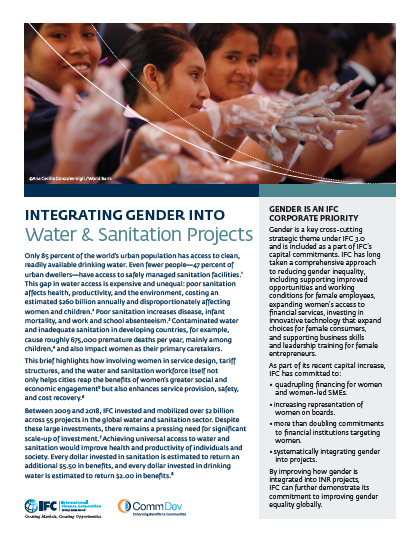
Integrating Gender into Water & Sanitation Projects
This brief highlights the benfits of cities involving women in service design, tariff structures, and the water and sanitation workforce
Highlights: Local Benefit Sharing in Large-scale Wind and Solar Projects
These are key highlights from the paper “Local Benefit Sharing in Large-Scale Wind and Solar Projects,” providing insights into the unique social challenges and opportunities for wind and solar developers.
Data in Action: Natural Resources Disclosure for People and Progress
his discussion paper consolidates the findings of D2D’s natural resources data assessments conducted in: Colombia, Ghana, Mongolia, and Peru. It describes key challenges and makes recommendations to industry, governments, and civil society that help bridge the existing data gaps and unlock data-enabled opportunities in the natural resources sector.
Unlocking Data Innovation for Social License in Natural Resources
This report describes how companies can use new data tools, approaches, and techniques to generate and sustain social license in communities.
Setting Site Water Targets Informed By Catchment Context: A Guide For Companies
This guide aims to help companies set effective site water targets that are informed by catchment context, which can create value and lessen risks for the company and support collective action.
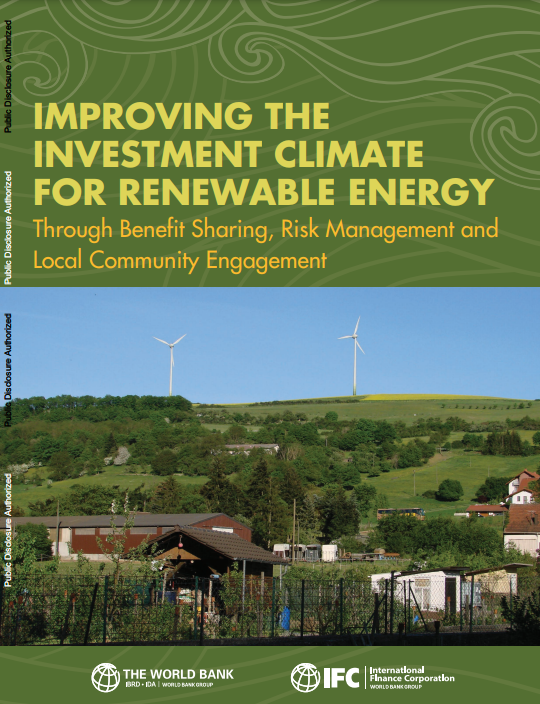
Improving the Investment Climate for Renewable Energy: Through Benefit Sharing, Risk Management, and Local Community Engagement
The study provides recommendations on how to improve the investment climate for renewable energy and wind energy, in particular, through benefit sharing, risk management, and local community engagement.
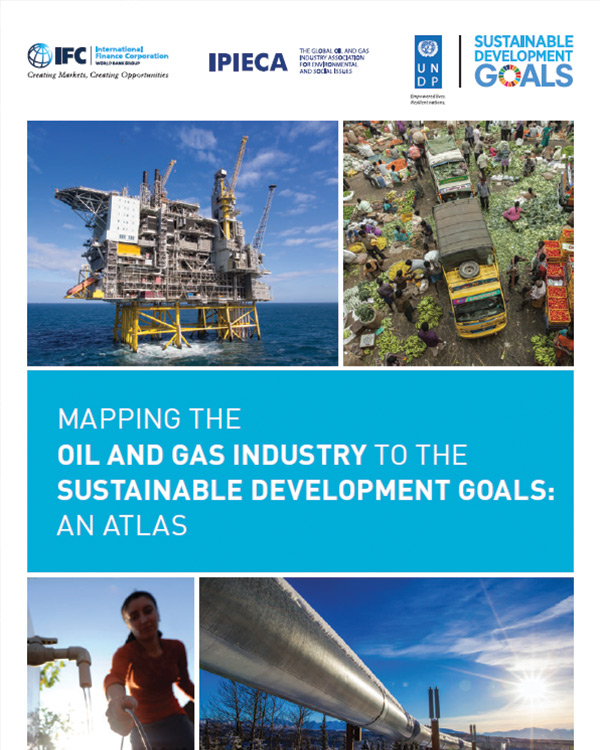
Mapping the Oil and Gas Industry to the Sustainable Development Goals: An Atlas
Achieving the SDGs by the target of 2030 will require unprecedented cooperation and collaboration among governments, non-governmental organizations, development partners, the private sector and communities.
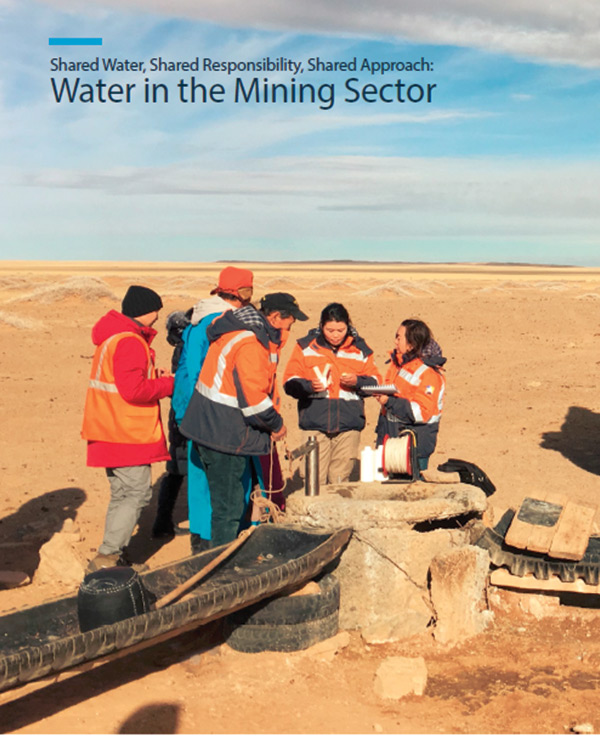
Shared Water, Shared Responsibility, Shared Approach: Water in the Mining Sector
Water scarcity poses a risk to companies in the mining and metals sector, but it also represents a significant opportunity–to catalyze collective solutions that improve water security and sanitation for all.
[Draft for Public Comment] Mapping the Oil and Gas Industry to the Sustainable Development Goals: An Atlas
Together with the United Nations Development Programme (UNDP) and IPIECA (the global oil and gas industry association for environmental and social issues), IFC has released for public review and commenting a draft report on how the oil and gas industry contributes to the Sustainable Development Goals (SDGs).
Mapping Mining to the Sustainable Development Goals: An Atlas
This Atlas maps the relationship between mining and the Sustainable Development Goals (SDGs) by using examples of good practice in the industry and existing knowledge and resources in sustainable development that if replicated or scaled up could make useful contributions to the SDGs.

Why Agreements Matter
A resource guide for integrating agreements into Communities and Social Performance work at Rio Tinto.
Mapping Mining to the Sustainable Development Goals: A Preliminary Atlas
The draft report is a collection of maps to help mining companies navigate where their products and activities – from exploration, through mining itself, to end products and eventually mine closure – can help the world achieve the SDGs.
An Investor’s Perspective: Long-Term Risk Assessment and Value Drivers for Mining Investors with Varying Time Horizons
Environmental sustainability factors related to mining operations can have significant impacts on both short and long term financial performance of mining companies.
Mining and Water: A Perspective on Legal and Regulatory Risks
This brief outlines the importance of taking into account legal and regulatory risks in investment decisions regarding copper and gold mines and briefly discusses the research the Columbia Center on Sustainable Investment (CCSI) is conducting to qualify and quantify those risks.
Report of the TSM Tailings Review Task Force
The Mining Association of Canada (MAC) has received the final report of the independent Task Force it commissioned to review its tailings management requirements and guidance under its Towards Sustainable Mining (TSM) initiative.
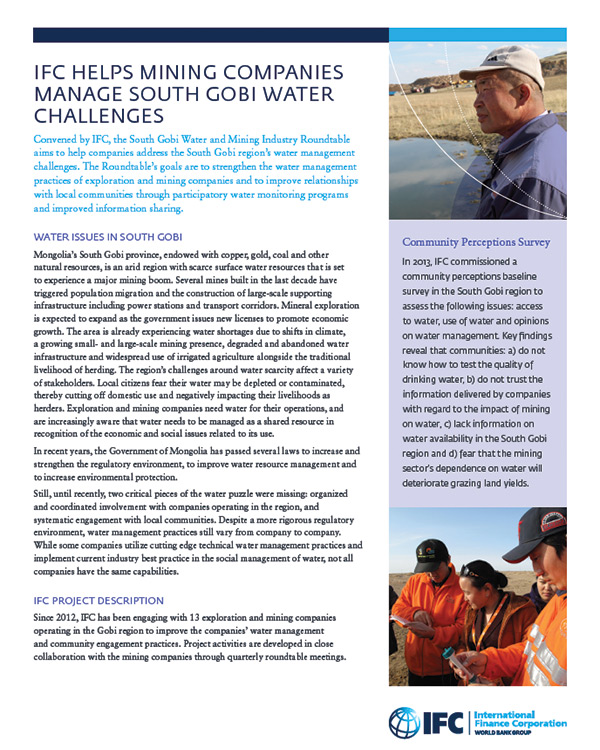
Water and Mining in Mongolia’s South Gobi Region
South Gobi Water and Mining Industry Roundtable About the Program Mongolia’s mining sector is a critical source of investment, accounting for nearly 40 per cent of government revenue, and local economic activity – and a key water user. The extraction, processing, and transportation of mineral resources could potentially bring significant changes to pastoral landscapes and […]
Rethinking the Value and Risks of Water for the Private Sector
What is the true value of water? What risks does water pose for the private sector? Why do various groups see the value of water differently, and how can these views be reconciled?
SUSTAIN: Cutting-edge business solutions magazine in Extractive Industries
SUSTAIN magazine presents cutting-edge business solutions for achieving stronger performance while addressing sustainability challenges.
A practical guide to catchment-based water management for the mining and metals industry
The guide aims to outline a comprehensive and systematic approach for identifying, evaluating and responding to catchment-based water-related risks.
SUSTAIN: Cutting-edge business solutions magazine in Agribusiness
How can companies across the world achieve stronger performance while addressing sustainability challenges? How can they learn from each other?
Water Stewardship Framework
ICMM’s Water stewardship framework outlines a common industry approach for what is a complex and locally-defined issue.
Baseline Community Perceptions Survey for International Finance Corporation – Final Report
In 2013, IFC commissioned a community perceptions baseline survey in the South Gobi region of Mongolia to assess the following issues: access to water, use of water and opinions on water management.
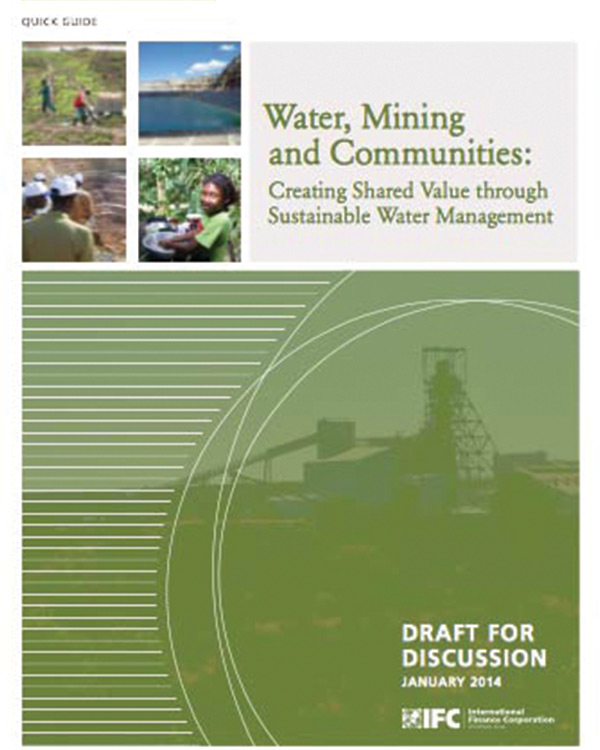
Water Mining and Communities
Mining companies are increasingly concerned about water risk at all levels: physical, regulatory, reputational and investor.
IFC Performance Standard Guidance Notes (3: Pollution Prevention and Abatement, ,4: Community Health, Safety, and Security, and 6: Biodiversity Conservation and Sustainable Management of Living Natural Resources)
IFC has prepared a set of Guidance Notes, corresponding to the Performance Standards on Environmental and Social Sustainability.
